
“Good work gets more work.”
The TPF Q&A with Human NYC’s Rachael Yaeger
Whenever I’m panicked about the state of business development, I hit up Rachael Yaeger to take the temperature. For 12 years, she’s co-run Human NYC, a creative studio that builds brands and websites for early-stage companies like Variety Coffee, CAVA, Hilma, and more. So she knows when potential clients want to spend money on creative and marketing work and when they want to hold off. It helps to have a friend and confidant to commiserate and celebrate with.
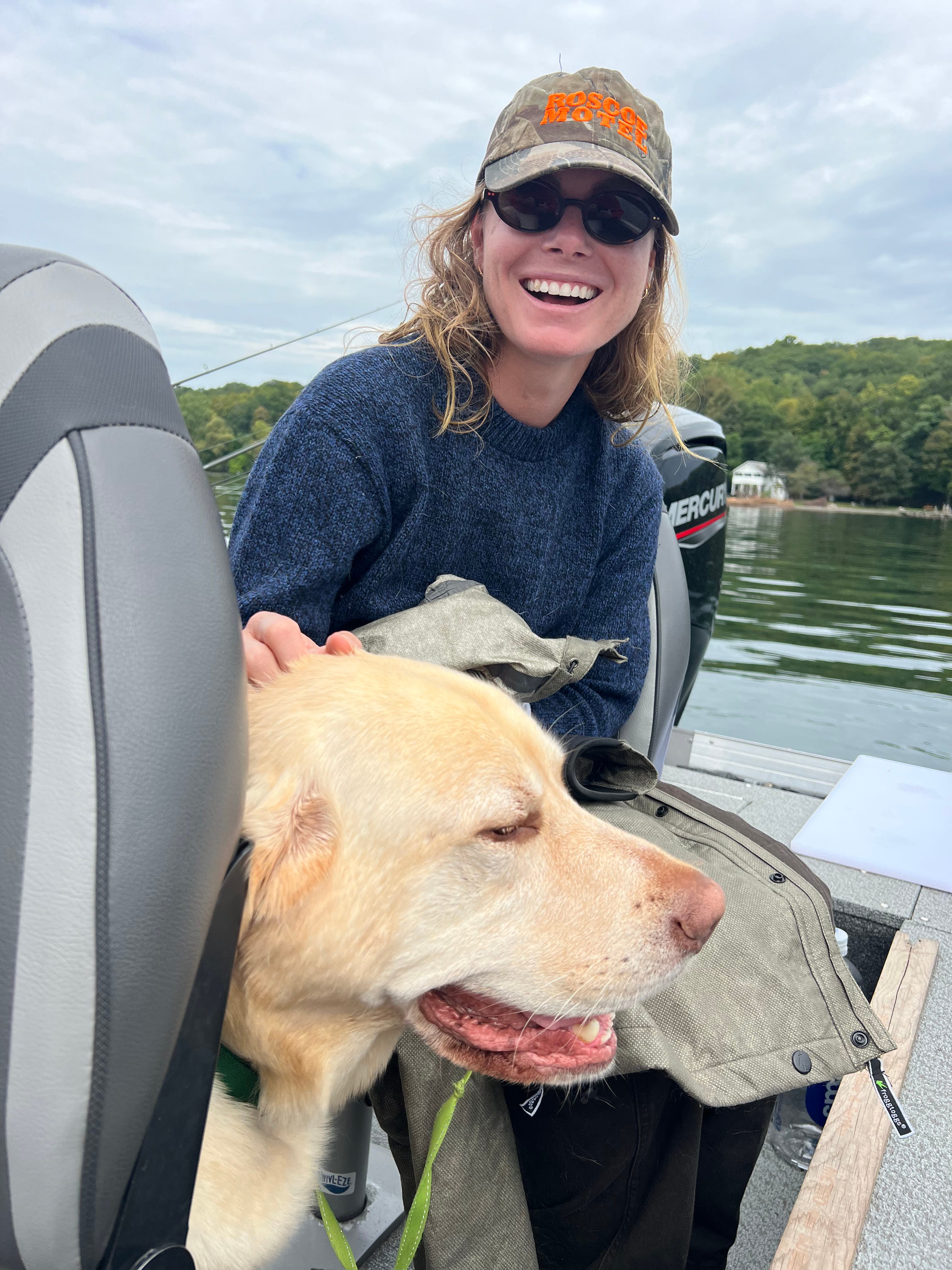
But Human does more than websites. Five years ago she and her business partner Michael Ray bought the Roscoe Motel in the Catskills, which is now a Human satellite office and, as Yaeger tells it, “a super fun adventure.” When she’s not running Human and the motel, she teaches at the School of Visual Arts in New York.
Three Point Four Media called up Yaeger to talk about the pros and cons of potentially getting acquired, the unconventional creative studio to motelier career path, and why she’s trying to be more like her auto mechanic.
So you bought a motel. Why?
[Laughs] The why, as corny as it sounds, is legacy and blood. My dad’s mom and then my parents ran the Cranberry Lake Inn in the Adirondacks. They sold it around the time I was born, but I grew up with all of this lore and storytelling around the Inn: snowmobiling, leaf peeping, lake life. They had 40 rooms and this bumping restaurant and bar.
When I got my graduate degree in Marketing and moved to the city and started working online my whole family told me how cool it was to work on the internet, because you can work from anywhere. If you get into hospitality, you’re super landlocked and will never get a vacation. But deep in my subconscious I always knew I wanted what they had. I love hosting people and being a place where people can come together.
Then, serendipitously right before the pandemic I drove by the motel, and it had a for sale by owner sign out front. I love the preservation side of things. I never wanted to create something from scratch, but like the idea of taking something and preserving it. My business partner Michael Ray and I have a really special relationship. He gives me a lot of freedom. So I got it inspected and did a little initial financial planning, and Michael was like, “Let’s do it. I can’t wait to change the light bulbs.” So we’ve had the motel for five years.
Is it technically part of Human?
Yeah, Human owns it. But it has its own LLC, its own tax ID, and its own bank account. I’m super open source about everything. Human has borrowed money from the motel. It’s a really financially secure business, knock on wood, because its demographic is recurring. It’s not a super profitable business, but it pays for itself.
When we bought the motel, we had an amazing full-time project manager at Human and the studio was doing really well; so it allowed me to get to know the motel. A couple years ago, right when Human needed my attention a little bit more, the motel had figured itself out. So it all evens itself out.
I want to be open minded and a sponge, but the best way for me to get new business is someone worked with us and then their friend or colleague or college roommate heard, “Human will do a really good job on your identity or your website, go talk to them.”
How does Human work? Are you 9-5, five days a week? Or is it more you get it done when you get it done?
I don’t run a company like Apple, where you’re going to get yelled at if I don’t see you on Slack.
There’s really high accountability on our team. The timeline is really clear. So it can totally be self-managed. But we always meet as a team at 10 am. It’s my favorite part of every single day. It anchors the whole team, even if we don’t have anything to say. It’s like, I’m here. I’m showing up. This is what you can expect from me and this is what I’m doing.
We have unlimited vacation days, and we’re really loose. If you have therapy, want to hit the gym, if your mental capacity is just not on from three to six and you want to code from 11pm to 1am—it doesn’t matter to me. It’s been a pretty lax year economically, so I think wiring in for the clients that we do have is important.
As any freelancer knows, it’s feast or famine right?
100% yes. I talked to Archie Coates and Jeff Franklin at Playlab when we shared a building. They gave me a metric that was three months of payroll in the bank. This was the first year in 12 years I had that runway. Now I’m getting to the end of that runway. So it’s always non-stop, even if you have a little bit of buffer.
“It’s about nurturing relationships and trying not to panic when it’s really dead.”
One thing I think people who don’t work in the industry don’t understand is how long business development takes and how it’s rarely the same. Sometimes a client comes to you with an immediate need. Sometimes it takes years. We did a project for Nike earlier this year that was the result of years of conversations with an old friend and colleague. What is your philosophy on biz dev? How do you do it?
I was and am still super lucky that a lot of our work is word-of-mouth inbound. I remember really vividly two years ago, I had inbox zero and I was panicked—because I’m new business and I don’t know what I’m doing! A work coach said you need to start advertising yourself on LinkedIn, you need to start doing more videos, and more traditional biz dev outreach. It just didn’t feel natural, and I will do anything for my business.
I want to be open minded and a sponge, but the best way for me to get new business is someone worked with us and then their friend or colleague or college roommate heard, “Human will do a really good job on your identity or your website, go talk to them.” But I agree with you, it’s about nurturing relationships and trying not to panic when it’s really dead.
I love the projects that recently have come in the door to us, and I want more of them. We’re just starting to hit our stride with RFPs where someone comes in and says, “Hey, we have a $200k RFP. We’ve worked with agencies a lot. We want it built on Sanity and it needs to be done in four months. Do you have the bandwidth?” And I’m like oh this is great. I’ve been waiting my whole career to get these really good RFPs vs. the amount of education and selling it takes with some potential friends or clients where I have to tell them, “I wish I could do this for $20k but, let me break it down for you: my payroll is $80k a month, so we’re never gonna be able to work on this, we’re going to hate each other at the end, and we’re not going to make any money.”
The why and the education around how much our creative and tech costs is important. I want to write an article about how much a website costs. I was chatting to ChatGPT and even ChatGPT knows a premium website is between $40k and $60k!
Just for the site! Not for the words or brand identity.
Yes! That’s what I teach at SVA. It’s called “practicing professional,” and it’s a lot of education around how to handle new work. If a client walks in the door, and they say, “I want a website.” The questions you have to ask are: Well, do you have a functioning business? Does that business have a name? Does it have a brand ID?
We always say websites are just gray boxes without content. Do you have content? Do you want an illustration? I’m still having the same intake convos after 20 years in this industry.
We didn’t sit down and write a manifesto or value propositions or think about the branding. If you want to make a business that has longevity and staying power and the reasons are not so monetarily driven, it’s about you, what you’re making, and who you’re doing it with—and you can keep doing that.
Do you guys do mostly project work? Are you looking for retainer work?
Michael and I didn’t want retainer work for a while because we wanted to go work on other things. We also believed that we were building the equivalent of a car or a home. We should be able to hand off this digital product and say, “Here’s the keys to the kingdom. Go drive it. Go learn from it. Go get revenue from it. And then come back to us when you need a new feature or a room.”
If you think of a website like a digital storefront at some point you might have a plumbing issue, want the bathroom redone, or need to redo the point-of-sale area. That is still how we want to work.
When I was really down and out a couple years ago I wondered, should I get acquired? I was researching how to position ourselves for that and it would be long-term contracts. I have a lot of friends that do work for Google, AmEx, and Nike, and I’m definitely not opposed to being a part of that infrastructure. We just haven’t. We have historically been this mid-sized project shop. So we do this $100k project really well, and then either help the client hire internally or do per-project work.
We do have a lot of recurring older clients that come back to us, but we don’t have that guaranteed $10k a month retainer. Not to say I wouldn’t be open to it, but it’s definitely not our business model.
We try to really just take the emotion out of money and be open minded. Look at the natural ebbs and flows of a business vs, we didn’t do a good job and that’s why we’re not getting hit up and your LinkedIn isn’t as cool as it should be.
So after you spent that time researching how to get acquired, did you strategically decide that you didn’t want to do it?
It was more me doing due diligence as the new business lead to be like, if I’m in charge of the livelihood of these partners and our studio, I just want to make sure I’m turning over every rock I possibly can.
A lot of the people I interviewed told me, “I got a $300k payout, but I’m in-house for the next five years, and I wish I had just stayed the course.” Michael and I, we have this saying: let’s make the math work. We try to really just take the emotion out of money and be open minded. Look at the natural ebbs and flows of a business vs, we didn’t do a good job and that’s why we’re not getting hit up and your LinkedIn isn’t as cool as it should be.
Once we ended up making the math work, we did downsize by two team members which was really hard for us to do but really necessary. So rather than getting acquired, we made the math work.
That dovetails nicely into my next question, which is what sort of advice would you give to someone starting their own shop?
My grandmother told me this and I just went and did it: A really good accountant* and a really good lawyer.
We still do this and you guys do this too: We focus on the work. Good work gets more work. We didn’t sit down and write a manifesto or value propositions or think about the branding. If you want to make a business that has longevity and staying power and the reasons are not so monetarily driven, it’s about you, what you’re making, and who you’re doing it with—and you can keep doing that. If that sounds fun, that’s what we’ve done, and it has been sustainable.
Knowing what you don’t know is important. I’m not afraid to figure it out, get into the weeds, and have tough conversations. Don’t shy away from the things you think you’re not good at, because if you’re a business owner you have to kind of be good at everything. Ask for help if you don’t understand something, I am really vulnerable with that kind of stuff.
It’s an interesting time, I have seen a lot of mid-sized studios pop up. It’s like when student becomes teacher—old interns of ours now have their own studios. I think there is an over-indexing on the brand and philosophy behind a studio. You haven’t even been around for six months, how do you declare this really finite offering and way of working? Letting yourself mature and be more restrained worked really well for us; it allowed us to grow and change and find our own lane.
How do you know when to tell a client they’re out of scope and ask for more money vs. just do the extra ask and be done with it?
Something I am trying to get better at is scope tracking and being good about telling a client hey we’re not down the bad road yet—but we can see it coming. [Laughs] It’s not your fault and it’s not our fault, but let’s try to course correct now. Trying not to be too you vs. me about it, but educating them about our experience from previous projects. Then we can talk about, is it more time? Is it more money? Is it more legwork on the client side? Is it concessions on our end?
My auto mechanic treats me like an equal even though I don’t know shit about cars. He over-educates me as to what’s happening, why it’s taking so long, didn’t have the part in stock, he had an eye exam—whatever the thing is, he’s so overly communicative and kind during the process that I try to take that over into client services.
It’s an ever evolving perfection of how to handle that!

 | A guest post by
|
yay Rachael!